dict
dict,中文是字典,英文是dictionary。
語法
dict是由花括號{}包住元素。
每一個元素都是key :冒號 value 所組成。
dict1 = {key1: value1, key2: value2, key3: value3}
空字典
1
2
3
4
dict1 = {}
dict2 = dict()
print(f"dict1={dict1} type(dict1)={type(dict1)}")
print(f"dict2={dict2} type(dict2)={type(dict2)}")
dict1={} type(dict1)=<class 'dict'>
dict2={} type(dict2)=<class 'dict'>
key
key只能是數字或字串。
以下的 key 為數字,輸出的類型為dict。
1
2
dict1 = {11: "Mary", 12: "Bill", 6: "John"}
print(f"dict1: {dict1}, type(dict1): {type(dict1)}")
dict1: {11: 'Mary', 12: 'Bill', 6: 'John'}, type(dict1): <class 'dict'>
以下的 key 為字串。
1
dict2 = {"001": "Mary", "002": "Bill", "003": "John"}
透過key取出內容
使用方括號[key]取出內容。
字典變數名[key]
dict1[11]
1
2
3
4
dict1 = {11: "Mary", 12: "Bill", 6: "John"}
print(f"11 = {dict1[11]}")
print(f"12 = {dict1[12]}")
print(f"6 = {dict1[6]}")
11 = Mary
12 = Bill
6 = John
若key為字串,可以使用雙引號或「單引號」包住key,單引號也是字串類型。
以下程式碼的key都是字串類型。
1
2
3
4
5
dict1 = {"s01": "Mary", "s02": "Bill"}
print(f" s01 = {dict1['s01']}")
print(f" s02 = {dict1["s02"]}")
print(f" s02 = {dict1["""s02"""]}")
print(f" s01 = {dict1['''s01''']}")
 s01 = Mary
 s02 = Bill
 s02 = Bill
 s01 = Mary
相同的key
若有相同的key,會取出位置在後方的key。
1
2
dict1 = {"s01": "Mary", "s02": "Bill", "s03": "John", "s01": "Bobo"}
print(dict1["s01"])
Bobo
value可以為任何類型
key只能是數字或字串,但value可以為任何類型。
1
2
3
4
5
6
dict1 = {
    "Mary": {"City": "Tokyo"},
    "Bill": 10,
    "Alex": [11, 20, 30]
}
print(dict1)
{'Mary': {'City': 'Tokyo'}, 'Bill': 10, 'Alex': [11, 20, 30]}
dict不能用index索引位置
若想取出索引位置為 0 的值,以下會有KeyError錯誤。
1
2
dict1 = {11: "Mary", 12: "Bill", 6: "John"}
print(dict1[0])
    print(dict1[0])
          ~~~~~^^^
KeyError: 0
迴圈
dict不支援while,只支援for。
in 字典變數
以下程式碼,in dict1,dict1為字典變數。
1
2
3
4
dict1 = {11: "Mary", 12: "Bill", 6: "John"}
# 方式1
for key in dict1:
    print(f"key = {key}, value = {dict1[key]}")
key = 11, value = Mary
key = 12, value = Bill
key = 6, value = John
keys() values()
透過keys()與values()可以取得key與value。
keys()範例如下:
1
2
3
4
dict1 = {11: "Mary", 12: "Bill", 6: "John"}
# 方式2
for key in dict1.keys():
    print(f"key = {key}, value = {dict1[key]}")
key = 11, value = Mary
key = 12, value = Bill
key = 6, value = John
value()範例如下:
1
2
for value in dict1.values():
    print(f"value = {value}")
value = Mary
value = Bill
value = John
items()
1
2
3
4
dict1 = {11: "Mary", 12: "Bill", 6: "John"}
# 方式3
for key, value in dict1.items():
    print(f"key = {key}, value = {value}")
dict操作函式
len(dict)
key元素數量。
若key有重覆,會去掉重覆的數量,以下的結果,數量為1。
1
2
dict1 = {"s01": "Mary", "s02": "Bill", "s03": "John", "s01": "Bobo"}
print(len(dict1))
3
新增修改
語法
dict[key] = value
以下程式碼,若 key 沒有在dict中,就是新增。
1
2
3
dict1 = {"s01": "Mary", "s02": "Bill"}
dict1["s05"] = "John"
print(dict1)
{'s01': 'Mary', 's02': 'Bill', 's05': 'John'}
若 key 已存在dict中,就是修改。
1
2
3
dict1 = {"s01": "Mary", "s02": "Bill"}
dict1["s01"] = "Sisi"
print(dict1)
{'s01': 'Sisi', 's02': 'Bill'}
刪除 del
語法
del dict[key]
若key不存在dict中,會KeyError。
1
2
3
dict1 = {"s01": "Mary", "s02": "Bill"}
del dict1["s01"]
print(dict1)
{'s02': 'Bill'}
pop()
語法
dict.pop(key, default)
若 key 不存在,傳回default , default 參數可不填。
沒有default,dict.pop(key),dict沒有key,則會KeyError。
pop(key),先把value取出,再執行 del dict[key] 刪除元素。
1
2
3
4
dict1 = {"s01": "Mary", "s02": "Bill"}
data = dict1.pop("s01")
print(f"data: {data}")
print(f"dict1 = {dict1}")
data: Mary
dict1 = {'s02': 'Bill'}
1
2
3
dict1 = {"s01": "Mary", "s02": "Bill"}
data = dict1.pop("s07", "Not found")
print(f"data: {data}")
data: Not found
keys()
取出所有的key,傳回值類型為dict_keys。
1
2
3
dict1 = {"s01": "Mary", "s02": "Bill"}
keys = dict1.keys()
print(f"keys = {keys} type = {type(keys)}")
keys = dict_keys(['s01', 's02']) type = <class 'dict_keys'>
類型為dict_keys,可使用for 取出內容。
1
2
3
4
dict1 = {"s01": "Mary", "s02": "Bill"}
keys = dict1.keys()
for key in keys:
    print(key)
s01
s02
key in dict
key為要搜索的key,若有此key,傳回True,找不到傳回False。
1
2
3
dict1 = {"s01": "Mary", "s02": "Bill"}
print(f" find s07 = {"s07" in dict1}")
print(f" find s02 = {"s02" in dict1}")
 find s07 = False
 find s02 = True
dict.clear() 刪除所有元素
1
2
3
dict1 = {"s01": "Mary", "s02": "Bill"}
dict1.clear()
print(dict1)
{}
zip()
使用zip可以把2個list合併成dict。
語法
{k:v for k,v in zip[list1, list2]}
以上的2個k 與v 要相同,k與v皆為變數名,可自由替換,非固定。
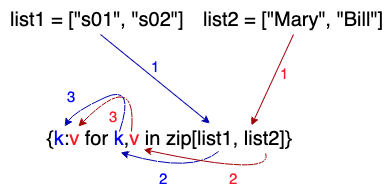
步驟如下:
- 取出
list1[0]與list2[0]的索引為0的元素。 list1[0]指派給klist[1]指派給v- k再指派給k v再指派給v
- 透過k、v,產生dict。
1
2
3
4
5
list1 = ["s01", "s02"]
list2 = ["Mary", "Bill"]
dict2 = {ele1:ele2 for ele1, ele2 in zip(list1, list2)}
dict1 = {k:v for k,v in zip(list1,list2)}
print(dict1)
{'s01': 'Mary', 's02': 'Bill'}